

Back in the 1990s, I finished my doctorate unusually quickly, taking just six years to complete both my master’s and my doctoral degrees, compared to the average of eight to ten years for many of my American classmates in the social sciences and humanities. There was a common misconception that international graduate students were brilliant — the best and the brightest drawn from all over the world — and that our academic outcomes were superior to those of our US counterparts. The truth was that the diligence and productivity of international students was an artifact of America’s immigration policy that held such students to impossibly high standards and stringent immigration regulations. We were tethered us to our classrooms and labs, with no freedom to veer from a rigid timetable for study and graduation.
Many of my American classmates began to take long breaks from their studies at around the three- to four-year mark in their graduate programs: some took on consultancies and part-time jobs; others simply decided it was all too much and took time off to contemplate their future; yet others quit the program altogether to start a family. But I plodded on, because if I didn’t, I risked falling out of legal status and would need to leave the US immediately.
The stakes for completing my education on time were much higher for me than for my US-born peers. That was over 25 years ago. Things have just gotten worse.
On July 16, the US government reversed a decades-long practice: where international students were once allowed to enter the US for the duration of their studies (technical term: Duration of Status), they are now restricted to four years. Many of my colleagues in the field have written eloquent and compelling op-eds and articles in the past few days about the policy details and implications of this development, and you can read some of them here and here, especially if you want to learn about the intricacies of the new policy.
As someone who has survived the straitjacket of the international student journey and written a memoir about it, I have so much to say and yet feel numbed into silence.
As a scholar and storyteller, my inclination is to turn both to the nuance of stories and the precision of data, but we have no stories yet since this is the first such development in decades. So the researcher in me finds herself returning to numbers to grapple with just how much is at stake.
The four-year rule is not grounded in reality: In 2024, doctoral students in the U.S. took an average of 7+ years to complete their degree. With their initial visa capped at four years, many international doctoral students will be just half way through their degrees when their time is up.
It hits where it hurts the most: Nearly 1.2 million international students study at American colleges and universities, and 57 percent of them are in STEM fields. A hard four-year cap affects those areas of American graduate education that need international talent the most. Foreign nationals make up 70 percent or more of full-time graduate students in fields such as petroleum engineering, electrical engineering, computer and information sciences, industrial engineering, and statistics. Between 2017 and 2022, international graduate enrollment in science and engineering grew by 49.3 percent, compared to 21.7 percent growth among American students. It isn’t only engineering and computer science. International graduate students and postdocs make up between 24 and 59 percent of researchers training in the biological and biomedical sciences at US institutions. Here is the statement from the Association of American Medical Colleges about the impact of this rule on the medical and health sector.
A country running out of its own students: The domestic pool of traditional American college-age students is in the middle of its own well-documented collapse. The shrinking cohorts now aging into college were born after the 2008 recession, when birth rates fell sharply. That dip is projected to shrink the pool of US college-age students by roughly 15 percent over the next five years. Higher ed governance experts already point to the international student pipeline as one of the few real buffers against this domestic "enrollment cliff," which makes constricting the flow of global talent a second hit, on top of the first. And it isn't a one-time problem: US fertility hit the lowest rate on record in 2024, meaning the domestic cohorts arriving after this one will be even smaller.
The damage is already visible
American campuses have already been reeling from a range of financial pressures, well before the rule takes effect. Since January 2024, there have been more than 300 instances of universities eliminating programs, closing departments, or laying off staff, tracked by the database CollegeCuts, and a growing number of schools now cite international enrollment declines as a trigger.
Where does the talent go instead?
I have always compared the flow of global talent to wealthy countries to the ebbs and flows of the stock market.
When one country within the Big Four (the U.S., the U.K., Canada and Australia) is down, others will be trending up because students will head there instead. But at this moment in time, all four countries are losing their international students.
The real winners are elsewhere. In one recent global survey, a large proportion of Asian and European universities reported growth in international undergraduate and postgraduate enrollment. France is explicitly positioning itself as the American alternative, aiming to host 500,000 international students by 2027, and its business schools have fast-tracked applications for US-bound students and built pathways for researchers affected by the restrictions on US universities.
There are consequences for the labor market as well. International students currently earn the majority of US master’s degrees in computer science and engineering. Half of international master’s graduates and three-quarters of doctoral graduates stay in the country to work, generally sponsored by the employers who need them.
Talent and aspiration doesn’t vanish when pushed away. It instead gets redirected elsewhere, to build labs, startups, and research programs in Paris, Seoul, or Singapore.
I lived the version of this system that made me sprint through my graduate degree, always fearful and always playing catch-up. But this new version of a four-year-clock trips international students mid-race, well before the finish line, and that has little to do with how a student in the U.S. — American or otherwise — actually finishes a degree.
Listen!
I had the pleasure of appearing on the TOEFL Talks podcast with host John Clark. Despite this being such a challenging time for international students, we revisited the appeal of an American education for South Asian students, while also talking about the current sentiments within the South Asian immigrant diaspora in the U.S. I also got to talk to John about my search for an elusive bunch of cilantro when I first landed in North Carolina from India. Take a listen.
C𝐨𝐧𝐬𝐮𝐥𝐭𝐢𝐧𝐠 𝐚𝐧𝐝 𝐭𝐡𝐨𝐮𝐠𝐡𝐭 𝐥𝐞𝐚𝐝𝐞𝐫𝐬𝐡𝐢𝐩 𝐜𝐨𝐚𝐜𝐡𝐢𝐧𝐠 𝐭𝐡𝐢𝐬 𝐬𝐮𝐦𝐦𝐞𝐫
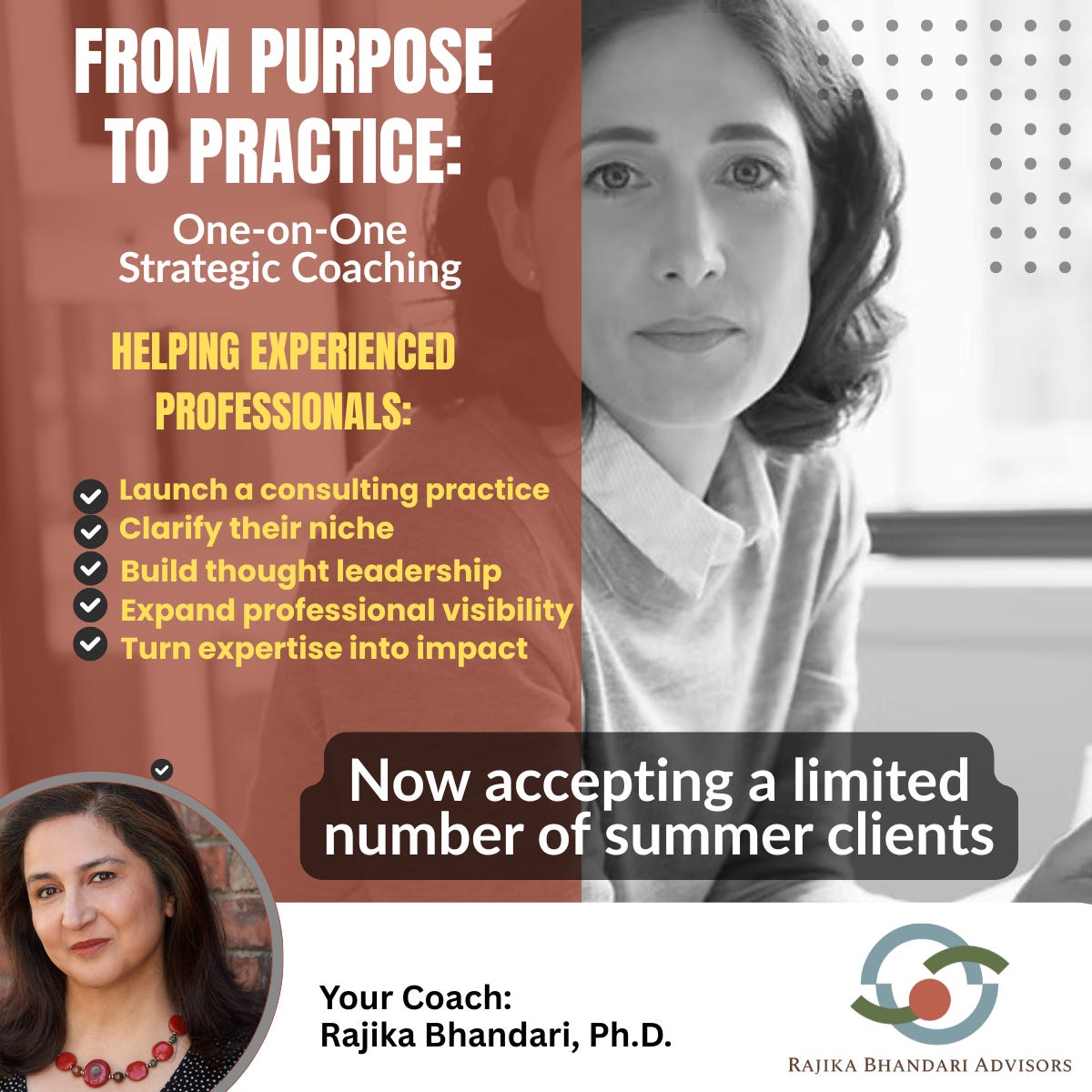
I have a few spaces open for one-on-one consulting and thought leadership coaching this summer. One of the most rewarding parts of my work is helping accomplished professionals take the next step in their careers and ideas. I offer personalized coaching grounded in more than two decades of experience in research, higher education, consulting, and entrepreneurship. Here are some ways in which I’ve worked with recent clients:
University-based academic and administrator with a new book: Enhancing visibility and developing a clear, lucrative thought leadership strategy.
Academic and expert retiring early: Identifying client markets and shaping subject matter expertise and academic experience into marketable services.
Seasoned professional in global multilateral sector: Strengthening personal thought leadership and brand within an existing organizational role.
If you’ve been thinking about investing in yourself or exploring what’s possible, I’d love to connect.

Glad to connect with you here at Substack, too, Rajika. I've been writing about some international student stuff on my site. https://www.collegetowns.org/p/no-international-students-are-not.
Good to have other people working on this space on Substack.