

Today, August 15, is marked by much pomp and pageantry in India, a day of celebrating the country’s independence from British rule in 1947. As a child I dutifully saluted the bold tricolor flag at school assemblies as it unfurled and released rose petals, while we stood at attention and sang the national anthem in unison.
Yet for much of my young adulthood, I did not fully grasp that behind the nationalistic pride of August 15 was a history of deep fractures and fault lines, when two nations were cleaved from one.
On the stroke of midnight on August 15, 1947, almost five million Hindus and Sikhs were displaced and forced out of the newly formed Pakistan—including my father’s family—while 5.5 million Muslims fled what became a Hindu-majority India. By the time the most tumultuous and violent phase of the Partition was over, more than fifteen million people had been displaced—the largest forced migration of its kind in modern history—and a couple of million had died in massacres or in their attempts to flee.
Just as the memory and narrative of the Holocaust is central to the identity of modern Jewish families in the US, the story of the Partition is woven into the fabric of many Punjabi families’ lives in post-independence India, especially those settled in Delhi. Following the Partition, a city that was once the seat of power of Muslim and British Empires was remade into a vast refugee colony, providing a haven to almost half a million Hindus who fled Pakistan.
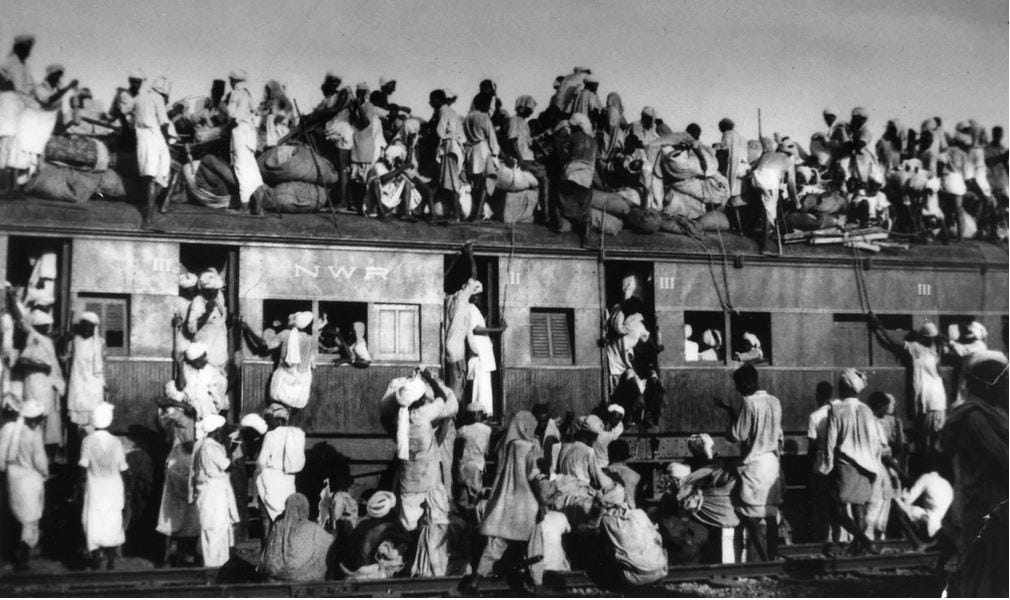
But despite the magnitude and horrors of the Partition and the role it played in displacing so many Indian families, rendering them refugees, I barely knew anything about it growing up. Other than a handful of films and books such as Khushwant Singh’s Train to Pakistan, the Partition and its aftermath didn’t occupy a place in the social awareness of my generation in India.
There seemed to be a carefully maintained silence about it and we didn’t fully understand the histories of where our grandparents had come from or have a sense of how the ravages of this forced migration—where all was lost—had affected generations to come. It has made me wonder over the years whether this was an attempt to erase it from our collective memory?
After coming to the U.S. and learning more about harrowing episodes in recent human history such as the Holocaust, I realized how little I knew about the Partition. I slowly began to piece together my family’s history by asking my grandmother about it during my visits back home. I learned how my grandparents fled Lahore with three children, carrying only what would fit in a few bundles and small trunks. My father, the oldest child, had barely any clothes—everything had been left behind except for what he was wearing the night they fled.


My grandmother made do the best she could: she would alter my grandfather’s discarded trousers for my father, and when he outgrew them, she would alter them again, shortening them for the next boy in line. Nothing was ever wasted or discarded. But even after things improved for the Bhandari family, the sense of frugality and impending loss never seemed to go away, and my grandmother continued to collect and hold on to things.
Despite everything she had surrounded herself with, despite the comfortable life she eventually came to lead in Delhi, she could never recover what she had lost in her journey as a refugee.
As Delhi began to overflow with thousands of refugees, my grandmother realized that she would never see Lahore again. The city was lost to her forever; there was no going back, no reclaiming of places or moments.
How this legacy continues to shape me
I had left home to learn more about America, but leaving India had helped me understand my own country’s history better. I am not alone in this realization. Guneeta Singh Bhalla, founder of The 1947 Partition Archive which has amassed and preserved over 9,300 oral histories from those who witnessed the events of 1947, has this to say:
“The 1947 Partition Archive couldn’t have been initiated in India. Being in the diaspora, I was unburdened by the identity politics that are so prevalent and mostly inescapable in South Asia today. I was an Indian American, looking to serve my homeland and looking to learn a bit more about my own heritage from a blank and unbiased lens.”
Her words captured something I had been feeling since my arrival in the U.S. but hadn’t articulated.
For many South Asians their family’s history cuts across different countries in the region, all of which were cleaved from a more singular identity and culture through a series of wars and ruptures. This was true for my family as well—one half of my family was originally from what became Pakistan.
Fresh off the boat (plane, actually) and ten thousand miles away from home, I began to seek the comfort of familiarity in the similar languages, similar foods, similar music, and popular culture that unites South Asians in the U.S.—we are more connected than different.
Many years later, when my career would come to center on international higher education, I began to notice the growing presence of those of South Asian heritage on our campuses—from international students, to first- and second-generation South Asian students whose parents emigrated to the U.S., to the thousands of faculty and administrators, to the growing numbers of presidents and chancellors who now lead U.S. institutions. An increasing number of leaders of nonprofits, think tanks, and companies that work alongside U.S. colleges and universities are also of South Asian origin.
But while we have organizations that connect journalists, lawyers, artists, and grassroots advocates across the South Asian diaspora in the U.S., to date no network or organization has tapped into the growing collective power of those whose work in higher education connects them to South Asia. It was with this vision of connecting back to our countries of origin, but also connecting across the U.S. that the idea of the South Asia International Education Network (South Asia-IEN) was born. The goal of SouthAsia-IEN is to be inclusive, recognizing the wide and deep historical, geographical, and cultural connections between the countries of South Asia, and across the widespread South Asian diaspora.

On this August 15, which for the sub-continent and its diaspora represents a day of celebration, suffering, but also the potential for working across borders, I’m so pleased to share that SouthAsia-IEN has just launched as a membership organization with offerings for individuals, institutions, and organizations. We are also planning our first summit—SANGAM, the South Asia Network Global Annual Meet—in Delhi, India, from December 16-18, 2026.
Sangam means the sacred meeting point of rivers. A place of gathering, where distinct streams of knowledge, culture, and ambition meet and become something greater than any one of them alone. I hope you will join us, both in membership and in Delhi.
For those who’d like to go deeper about the Partition, here’s where I’d start


Train to Pakistan by Khushwant Singh. This remains one of the earliest and most important accounts of the Partition by veteran Indian journalist and author, Khushwant Singh.
Cracking India by Bapsi Sidhwa. Another classic, Cracking India was also made into a must-see film, Earth, by the Indian Canadian director, Deepa Mehta.
Midnight’s Furies: The deadly legacy of India’s Partition by Nisid Hajari. A masterful non-fiction account that was on many “best book” lists in 2015.
Remnants of a Separation by Aanchal Malhotra. I love this book because it tells the story of the Partition through objects that were lost and found and that remained as heirlooms even though families were split apart.
Shattered Lands: Five Partitions and the Making of Modern Asia by Sam Dalrymple. A newer addition to the Partition genre, framed through the repeated partitions and cleaving of the sub-continent.
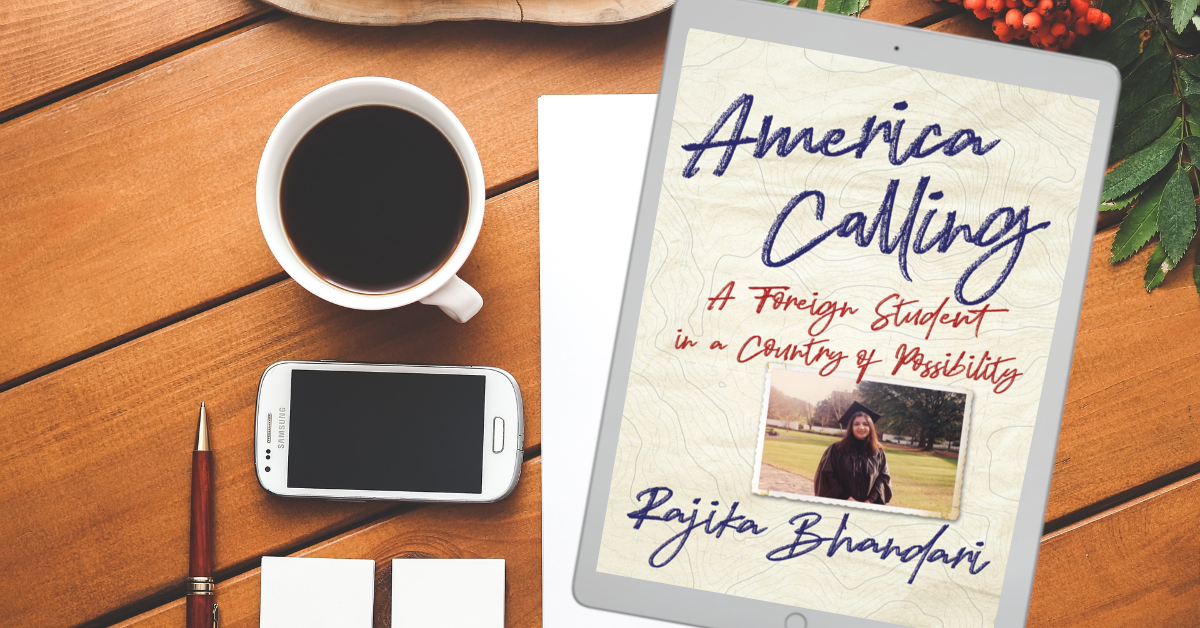
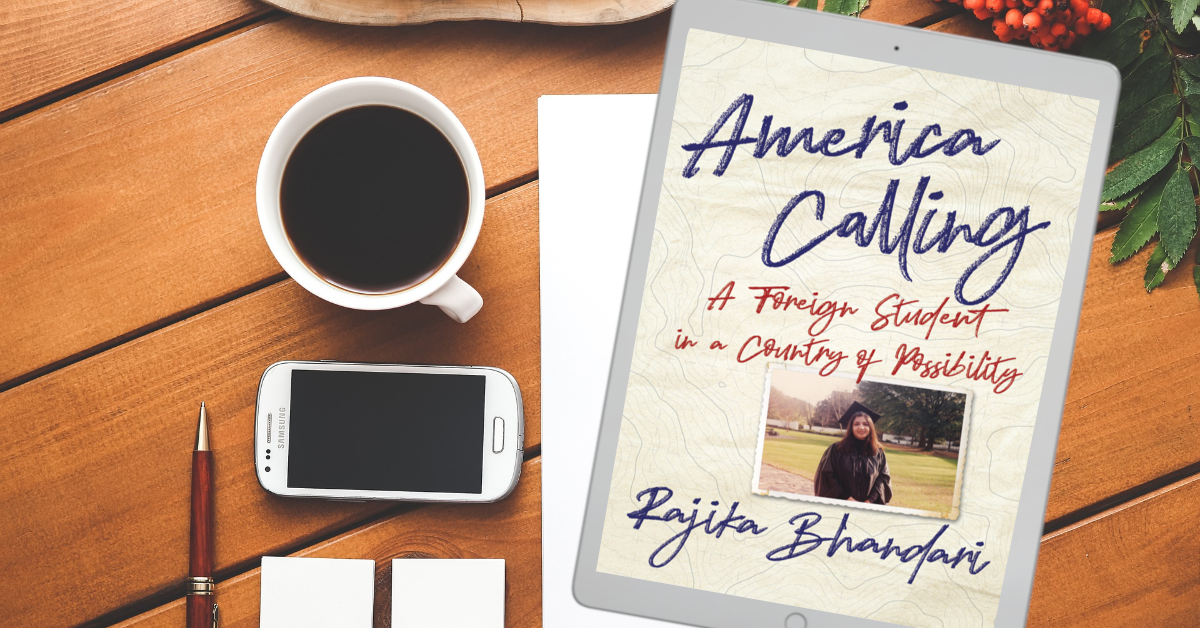
Get Your Copy of America Calling!
Thanks for writing about the Partition, Rajika. Recently, not a day goes by that I don’t think of my parents and grandparents who were forced to flee from what is now West Pakistan or West Punjab, who lost everything in the process and became refugees in Delhi, stayed in camps or small accommodations for years. I cannot believe that somehow they recovered from these losses, even did very well. But they maintained a silence that you mention here. This is what most bothers me, too, now, because growing up I did not learn much about this partition and its horrendous unexplainable effects on not only them but also the future generations, including us.
What a beautiful poignant story! Placing partition within your family’s history makes it real for me. Thanks Rajika.